
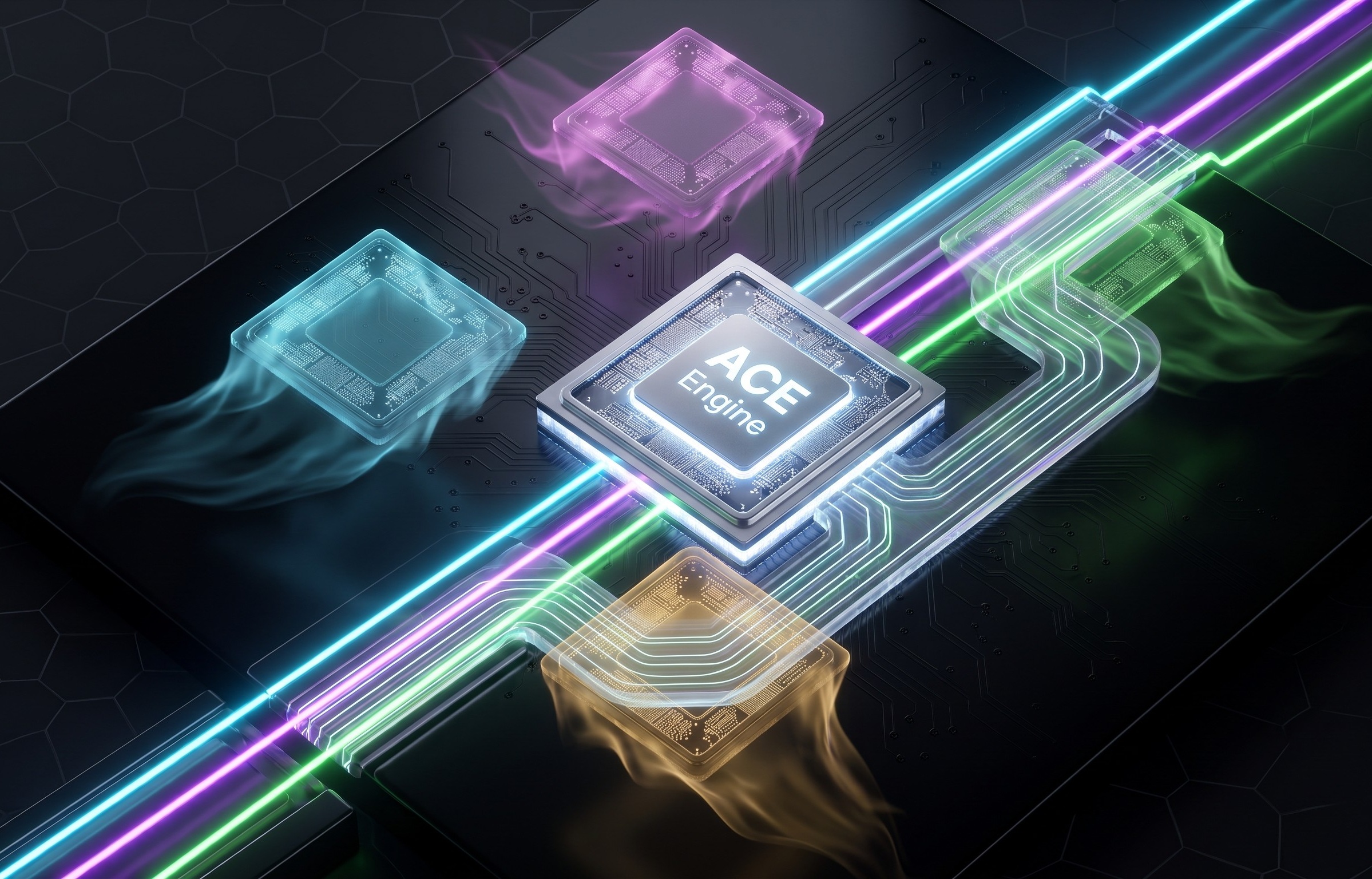
Neural ACE - Deterministic Edge AI

Deterministic Edge AI for Mission-Critical Physical Dynamics

From trained PyTorch neural networks to cycle-accurate, zero-jitter FPGA silicon—in minutes. With an execution engine whose silicon footprint is completely decoupled from model size.

  • Cycle-Accurate Determinism: Branchless, time-predictable pipeline. Zero execution jitter, zero operating system overhead.
  • Hardware-Decoupled Scaling: Network depth, layer sizes, and parameter counts scale execution cycles, never your FPGA logic gates or DSP blocks.
  • Arbitrary MIMO Topologies: Train and deploy multi-input, multi-output networks for mechatronics, aerodynamics, turbomachinery, biomedicine or state-estimation.
  • Runtime Reconfigurable: Update weights, layer connections, or entire model topologies in-flight via standard memory-mapped buses (e.g. AXI/LMB) without reloading FPGA bitstreams.
  • Bit-Exact Software Twin: Direct bit-level alignment between PyTorch simulation and physical FPGA BRAM registers.
3D Point-Cloud Registration Engine Resource Breakdown and Timing Performance on AMD Artix-7 100T FPGA

Why Edge Intelligence Fails at Physical Dynamics — And How NeuralACE Solves It

Real-world physical processes—from fluid drag and turbomachine stall to magnetic air gaps and joint stiction—are non-linear, dynamic, and multi-variable. Traditional industrial computing forces engineers to choose between two unacceptable extremes: mathematical models that are too basic to adapt, or AI processors that are too unpredictable for real-time control.

Traditional NPUs & Edge GPUs (Non-Deterministic Jitter)

The Limitation: Built for bulk vision or batch tensors, NPUs introduce unpredictable memory caching, bus contention, and OS thread scheduling. Latency spikes of 50–200 μs make them unusable for hard real-time loops.

The NeuralACE Breakthrough: 100% Branchless Cycle-Determinism. NeuralACE implements the neural network directly on silicon logic. Every inference takes a fixed, mathematically verified number of clock ticks. Zero jitter, zero operating system, sub-microsecond response.

Direct RTL & HLS Synthesized Networks (Silicon Resource Explosion)

The Limitation: Standard FPGA tools instantiate physical multipliers for every neuron in the network. Adding layers quickly consumes all available DSP slices and LUTs, forcing designers onto expensive, power-hungry high-end FPGAs.

The NeuralACE Breakthrough: Complete Resource Decoupling. NeuralACE relies on a time-multiplexed, N-lane parallel execution core. Your FPGA hardware footprint remains strictly fixed regardless of layer depth or parameter count. Scaling model complexity only adjusts cycle execution time, never your silicon logic budget.

Look-Up Tables & Classical PID (Curse of Dimensionality)

The Limitation: Linear PID ignores non-linear dynamics, while multidimensional look-up tables (LUTs) expand exponentially in memory size with every new input variable.

The NeuralACE Breakthrough: Arbitrary Multi-Input / Multi-Output (MIMO) Mapping. Seamlessly maps high-dimensional non-linear interactions into compact INT8 neural weights, evaluating complex kinematics without exponential memory grids.

Hard-Coded Silicon Models (Inflexibility & Mechanical Drift)

The Limitation: Machine mechanics shift over time due to wear, temperature variations, and tool replacement. Static ASIC or fixed FPGA pipelines require a complete hardware re-spin or bitstream rebuild to update control parameters.

The NeuralACE Breakthrough: In-Flight Memory-Mapped Reconfiguration. Program memories are accessible over standard Dual-Port RAM interfaces. Host processors can flash updated neural topologies, fresh calibrations, or wear-compensated model weights online without interrupting machine runtime.

The Core Architecture

A time-multiplexed, programmable co-processor engineered for synchronous control loops.

  • Branchless Cycle-Determinism: Zero execution jitter; every network layer runs in a mathematically fixed number of clock ticks.
  • Decoupled Silicon Footprint: Model depth and neuron density scale clock cycles, never your FPGA LUTs or DSP blocks.
  • Multi-ROM Activation Tables: Hardware lookup tables support hybrid activations (LeakyReLU, linear passthrough, or custom non-linear curves) selectable per layer.
  • In-Flight Reconfigurability: Update microcode and model weights online via standard memory-mapped buses (e.g. AXI/LMB) without bitstream reloading.
Neural ACE Core Architecture

Proven Across Mission-Critical Domains

A Single Unified Bitstream Across All Domains

Every benchmark domain below was deployed and executed on physical FPGA hardware using the exact same synthesized bitstream. Modifying network topologies, expanding layer depths, or changing physical control dynamics requires zero bitstream re-synthesis and zero FPGA reprogramming—models are updated in-flight simply by streaming compiled VLIW microcode and INT8 coefficients into on-chip BRAM via standard memory-mapped buses.

Sub-1% Silicon Footprint

Validated on an entry-level AMD Artix-7 (xc7a100tcsg324-1) clocked at 200 MHz:

  • Standalone Neural ACE Core (orchestrator_top): Consumes only 487 Slice LUTs (0.77%), 6 DSP48E1 slices (2.50% / 1 DSP per compute lane), and 1,046 Flip-Flops (0.82%), leaving over 99% of FPGA logic and 97% of DSPs completely free for customer motor drives, sensor interfaces, and communications.
  • Turnkey Testbed Harness: Even when paired with an on-chip MicroBlaze CPU, AXI interconnect, and UART bridge for live hardware validation, the entire combined system uses just 4.25% LUTs (2,696) and 3.75% DSPs (9).

Automated Model-to-Silicon Verification

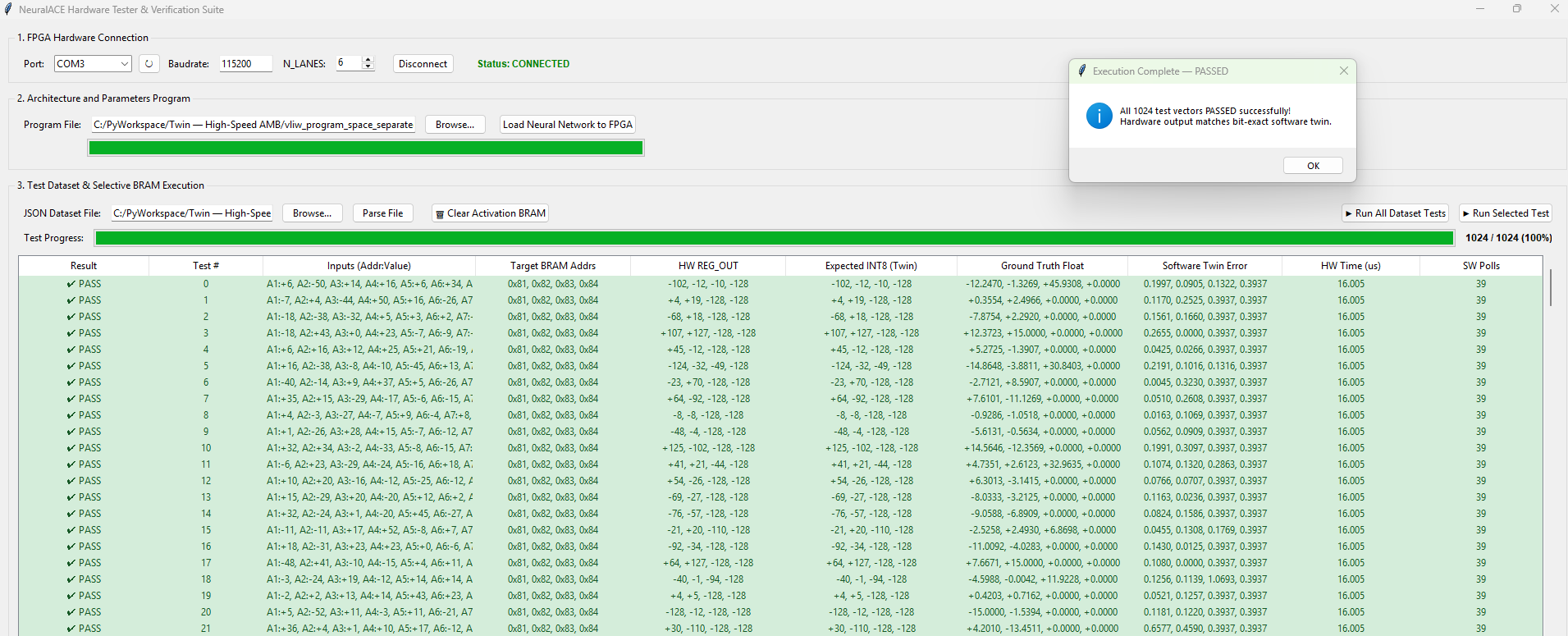
Networks are trained using Quantization-Aware Training (QAT) in PyTorch, automatically compiled into cycle-deterministic microcode by our toolchain, and verified live on silicon. Across thousands of live hardware test vectors streamed via our automated verification harness, Neural ACE achieves 100% bit-exact parity (0 LSB hardware error) against the software reference model.

NeuralACE Hardware Tester and Verification Suite showing 1024/1024 bit-exact hardware test vectors passed
Live FPGA Hardware-in-the-Loop Verification Suite: 1,024 test vectors validated with 100% bit-exact parity against the Python software twin.
High-Speed Drone Aerodynamics
High-Speed Magnetic Bearings & Turbomachinery
Closed-Loop Artificial Pancreas
Permanent Magnet Synchronous Motors

Direct Integration into Specialized Math Engines

While Neural ACE is available as a lightweight, standalone neural network co-processor, neural network models can also be embedded directly inside specialized ACE Math Engines.

By coupling neural non-linear function approximation directly with IEEE-754 floating-point pipelines, kinematic transforms, and CORDIC vector engines on a single silicon fabric, the combined core maximizes execution speed, eliminates bus arbitration delays, and streamlines system integration:

To see an end-to-end production co-processor combining Neural ACE with precision Field-Oriented Control and dynamic friction cancellation in 12.250 microseconds, visit the ACE910N01 Motion Control & Dynamic Friction Compensation Accelerator page.

What We Offer: The Complete Model-to-Silicon Delivery

Everything you need to train, compile, verify, and deploy deterministic AI on your hardware. Whether you need a standalone AI coprocessor IP or a fully tailored mechatronic accelerator, Accelerated Computing Engineering provides an end-to-end toolchain that removes the complexity of FPGA RTL design.

1. Synthesizable IP Core & Silicon Integration

  • Production-Ready IP Core: Turnkey synthesizable RTL / netlist delivery with full timing closure constraints for AMD/Xilinx, Intel/Altera, Microchip FPGAs, or custom ASIC targets.
  • Bus-Agnostic Interface: Standard Dual-Port RAM memory-mapped interfaces ready for immediate connection to AXI4-Lite, AXI4-Stream, or LMB buses.
  • Hyper-Integration Support: Ability to hyper-integrate custom hardware math blocks (CORDIC trigonometry, vector Clarke/Park transforms, Space-Vector PWM, or Kalman filters) into the same single-pipeline execution core.

2. Complete Training & Compilation Toolchain

  • Standalone QAT GUI Executable: A code-free desktop tool for control and test engineers to import experimental trajectory data, define layer topologies, and execute automated Quantization-Aware Training (QAT).
  • Python / PyTorch NeuralACE SDK: A flexible library for advanced R&D and data science teams to embed custom non-linear loss functions, multi-ROM activations, and domain-specific dynamics into existing training pipelines.
  • ACE Cloud Compilation Portal: Secure compilation service that automatically ingests your trained PyTorch models (.pt) and outputs programming files ready for instant deployment.

3. Verification & Twin Validation

  • Bit-Exact Software Twin: Python-based hardware twin that guarantees 100% bit-level agreement with physical FPGA registers before touching silicon.
  • Automated JSON Test Vector Harness: Automated validation suite generating comprehensive stimulus/response datasets to verify timing, numerical boundaries, and physical precision.

Data Privacy note: By contacting us via email, you agree that we will use your provided contact details and mathematical specifications solely to evaluate project feasibility during our early-access phase. We do not sell or share your personal information with third parties. We may use standard web analytics tools to monitor basic, aggregated website traffic to improve our site performance.